
Top Liquid Rubber Waterproof Sealant Picks for DIY Homeowners
Best Liquid Rubber Waterproof Sealant Picks by Project
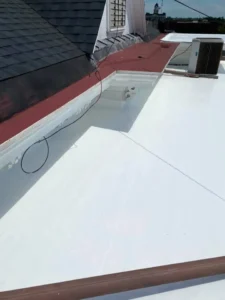
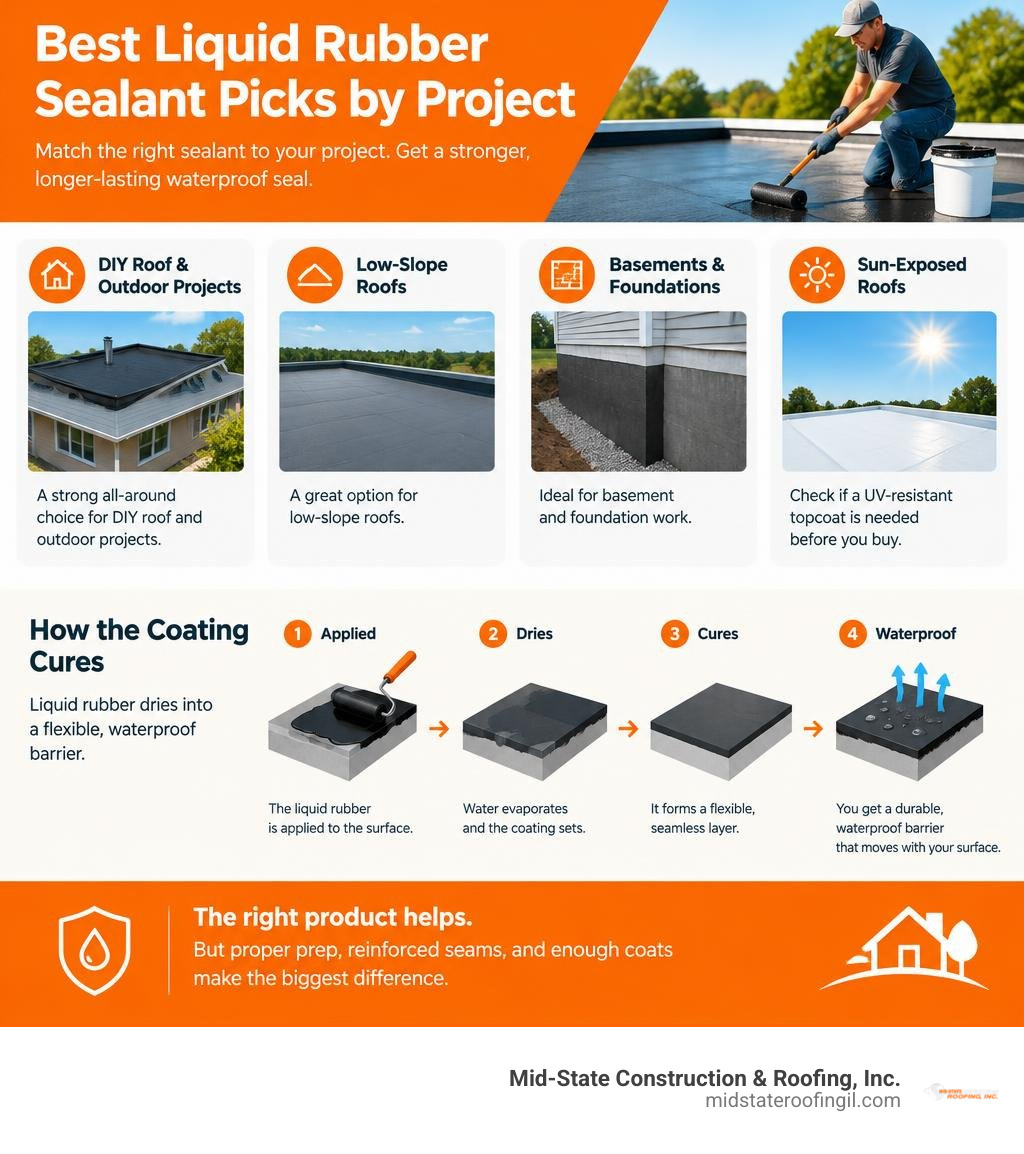
The best liquid rubber waterproof sealant depends on where you use it. Choose a flexible, manufacturer-approved coating suited to your surface, whether you are handling a DIY roof repair, a low-slope roof, or basement and foundation waterproofing. For a sun-exposed roof, check whether the product needs a UV-resistant topcoat before you buy.
These coatings dry into a flexible waterproof layer, but the right product alone will not stop a leak. Surface prep, reinforced seams, and enough coats matter just as much. This roundup will help you match a sealant to your project and know when a roof needs more than a coating.
I’m Virgil Strauch, and my background in planning and overseeing projects shapes how I assess the best liquid rubber waterproof sealant: by project fit, application needs, and upkeep. Let’s start with the features that make those picks different.
Essential best liquid rubber waterproof sealant terms:
How to Choose the Best Liquid Rubber Waterproof Sealant for Any Project

Finding the right elastomeric barrier starts with understanding your substrate and exposure conditions. Liquid rubber formulas cure into a seamless membrane that expands and contracts with daily temperature shifts. Depending on whether you are sealing a shed roof, a foundation wall, an RV roof, or a concrete water feature, different chemical formulations offer distinct advantages.
When selecting a waterproof sealant coating for roofs, check how each formula balances elongation, curing behavior, and chemical composition:
| Feature / Coating Type | Water-Based Elastomeric | Solvent-Based Rubber | High-Solids Silicone |
|---|---|---|---|
| Typical Elongation | 900% to 1200% | 400% to 600% | 200% to 400% |
| VOC Content | Zero to ultra-low VOCs | Moderate to high VOCs | Very low VOCs |
| Odor Level | Low / odorless | Strong chemical fumes | Mild odor |
| Standing Water Resistance | Good (with proper mil build) | High | Excellent (indefinite ponding) |
| Cleanup Method | Warm soap and water | Mineral spirits or xylene | Solvents / single-use rollers |
| Indoor Safety | Safe for basements and planters | Requires active ventilation | Safe with ventilation |
Key Performance Factors of the Best Liquid Rubber Waterproof Sealant
The defining characteristic of premium liquid rubber is high elasticity. Look for a coating with elasticity appropriate for the substrate and expected temperature changes. This flexibility prevents adhesion failure when building materials shift during seasonal freeze-thaw cycles in Central Illinois communities like Effingham, Shelbyville, and Vandalia.
Standard roof coatings can crack when joints expand, but an elastomeric membrane bridges hairline surface voids. Building adequate dry film thickness is essential to resist standing water and resist tearing under mechanical strain.
Comparing Water-Based vs. Solvent-Based Formulations
Water-based liquid rubber formulations have become the industry standard for residential DIY projects. Because they contain no solvents or volatile organic compounds (VOCs), they do not emit noxious odors. This makes them practical for enclosed spaces such as basement walls, concrete cisterns, and indoor storage areas.
Solvent-based coatings cure more quickly in cool or damp weather and resist immediate wash-off from sudden rain showers. However, they require personal protective equipment, strict ventilation, and hazardous-material disposal for cleanup. Following a guide to finding the best roof coating helps you match the solvent profile to your working environment and local clean-air standards.
Top Membrane Solutions for Roofs, Foundations, and RVs
Different projects demand specialized performance properties:
- Flat and Low-Pitch Roofs: Flat decks are prone to ponding water, which softens inferior acrylic paints. You must seal low-slope roofs to prevent rot using high-build rubberized coatings reinforced with polyester fabric across all transitions.
- Basements and Below-Grade Foundations: Specialized foundation sealants can help create a protective barrier against hydrostatic pressure on exterior masonry, cinder block, and poured concrete walls.
- RV Roofs and Campers: Travel trailers flex continuously on the highway. Using dedicated elastomeric membranes designed for RV roofs accommodates this continuous movement without peeling.
- Commercial and Residential Metal Roofs: When treating metal buildings, pairing a flexible base coat with EPDM acrylic roof coating systems seals fasteners and laps while reflecting solar radiation.
Step-by-Step Application Guide and Professional Support

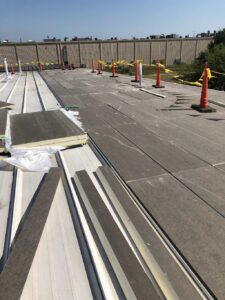
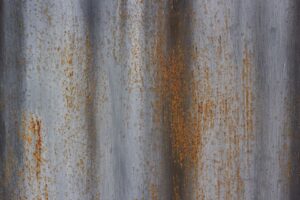
Applying a liquid membrane is straightforward, but thorough prep work is necessary for a long-lasting seal. Applying a premium liquid rubber over dirty, oily, or flaking surfaces will lead to bubbling and early coating failure. Larger commercial facilities often require full commercial roof coating restoration to address compromised insulation or structural rust before applying liquid membranes.
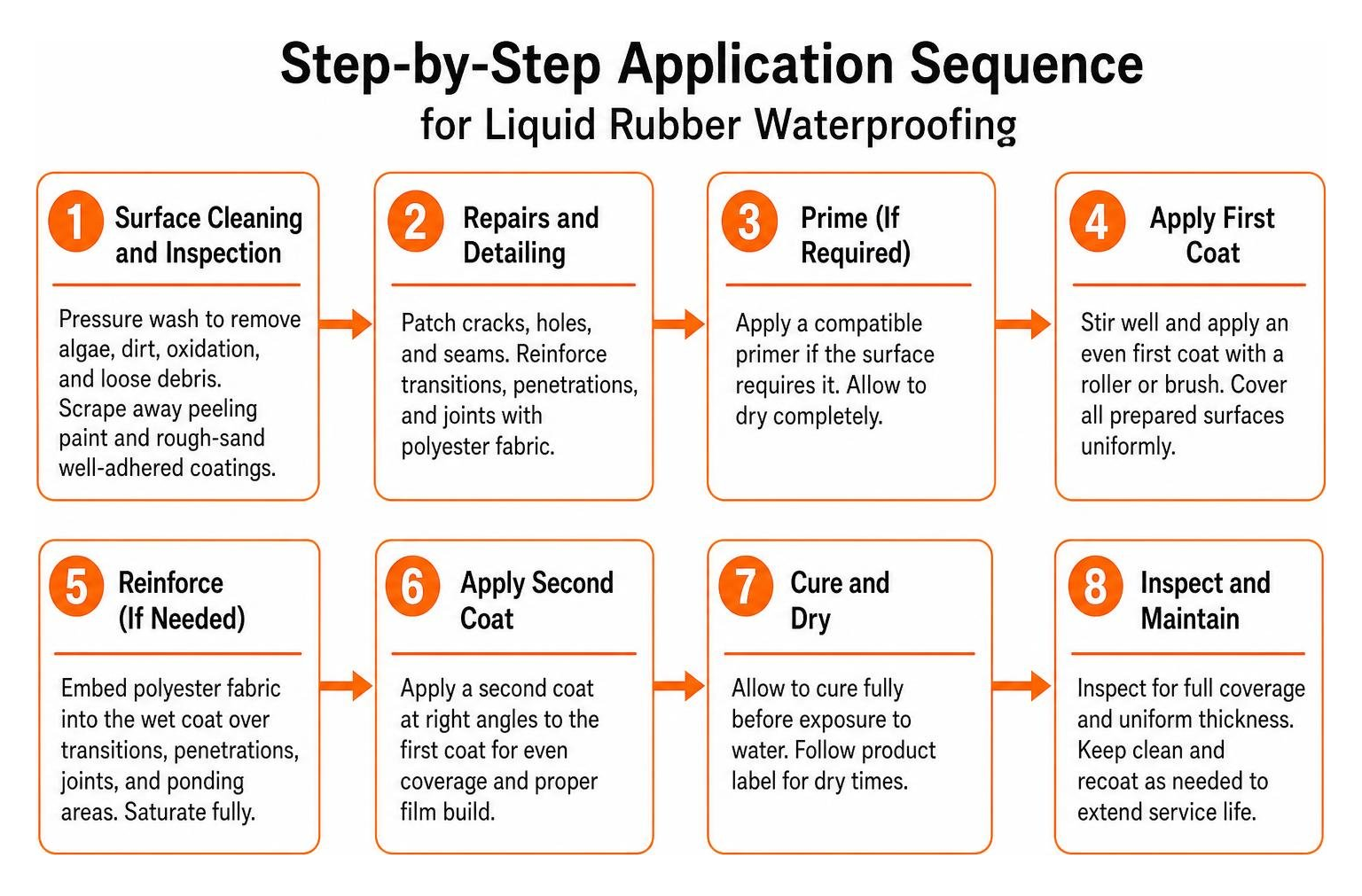
Applying the Best Liquid Rubber Waterproof Sealant for Maximum Durability
For reliable DIY waterproofing, follow this multi-step application method:
- Surface Cleaning and Inspection: Pressure wash the substrate to remove algae, dirt, oxidation, and loose debris. Scrape away peeling paint and rough-sand well-adhered existing coatings to create a mechanical profile.
- Moisture Testing: Ensure the substrate is dry. Trapped water vapor will blister the elastomeric film once the sun warms the roof.
- Detail Seam Reinforcement: Treat seams, cracks, flashings, and fasteners using the three-course method: apply a heavy coat of liquid rubber, embed stitch-bonded polyester tape or geotextile fleece, and saturate the top with another layer of sealant.
- Field Application: Apply multiple even coats using a 3/8-inch microfiber roller, brush, or heavy-duty airless sprayer. Vertical surfaces require 3 to 4 coats to achieve roughly 30 mils of thickness (around 30 square feet per gallon). Flat surfaces subject to ponding water need 4 to 5 coats to reach 60 to 80 mils of dry film thickness (roughly 15 square feet per gallon).
- Substrate-Specific Primers: When working on single-ply membranes, consult a comprehensive EPDM roofing maintenance overview to verify if an adhesion-promoting wash primer is required before coating.
Review the product label and technical data sheet to confirm you are applying the recommended coat counts and mil thickness for your specific material.
Curing Times, Weather Limits, and Longevity Expectations
Liquid rubber sealants cure by evaporation and cross-linking. Ideal application conditions require temperatures above 50°F (and strictly above 40°F) with relative humidity below 85%. Do not apply the coating if rain, frost, or heavy dew is forecast within 24 to 48 hours.
Under typical summer conditions (70°F and 50% relative humidity), each coat dries to the touch in 4 to 8 hours and is ready for recoating within 12 to 24 hours. Full cure takes 24 to 48 hours, though complete chemical cross-linking continues over several days.
A properly applied liquid rubber coating delivers an average lifespan of 5 to 10 years before requiring a maintenance topcoat. For high-temperature flat roofs, silicone roof repair alternatives can provide 10 to 15 years of ponding resistance.
If your roof shows signs of extensive moisture intrusion, rotted decking, or failing seams across large sections, a simple bucket of DIY sealant may not resolve the underlying structural damage. Mid-State Construction & Roofing, Inc. provides residential and commercial property owners throughout Effingham, Altamont, Beecher City, Hillsboro, Litchfield, Ramsey, Salem, Shelbyville, and Vandalia with comprehensive roof restoration, professional inspections, and warranted installations.
Visit our professional roofing and coating solutions page to schedule a professional evaluation and make sure your property stays dry through every season.