
Asbestos Roof Leak Repair: Safe and Simple Ways to Patch the Drips
Safe First Steps for Asbestos Roof Leak Repair
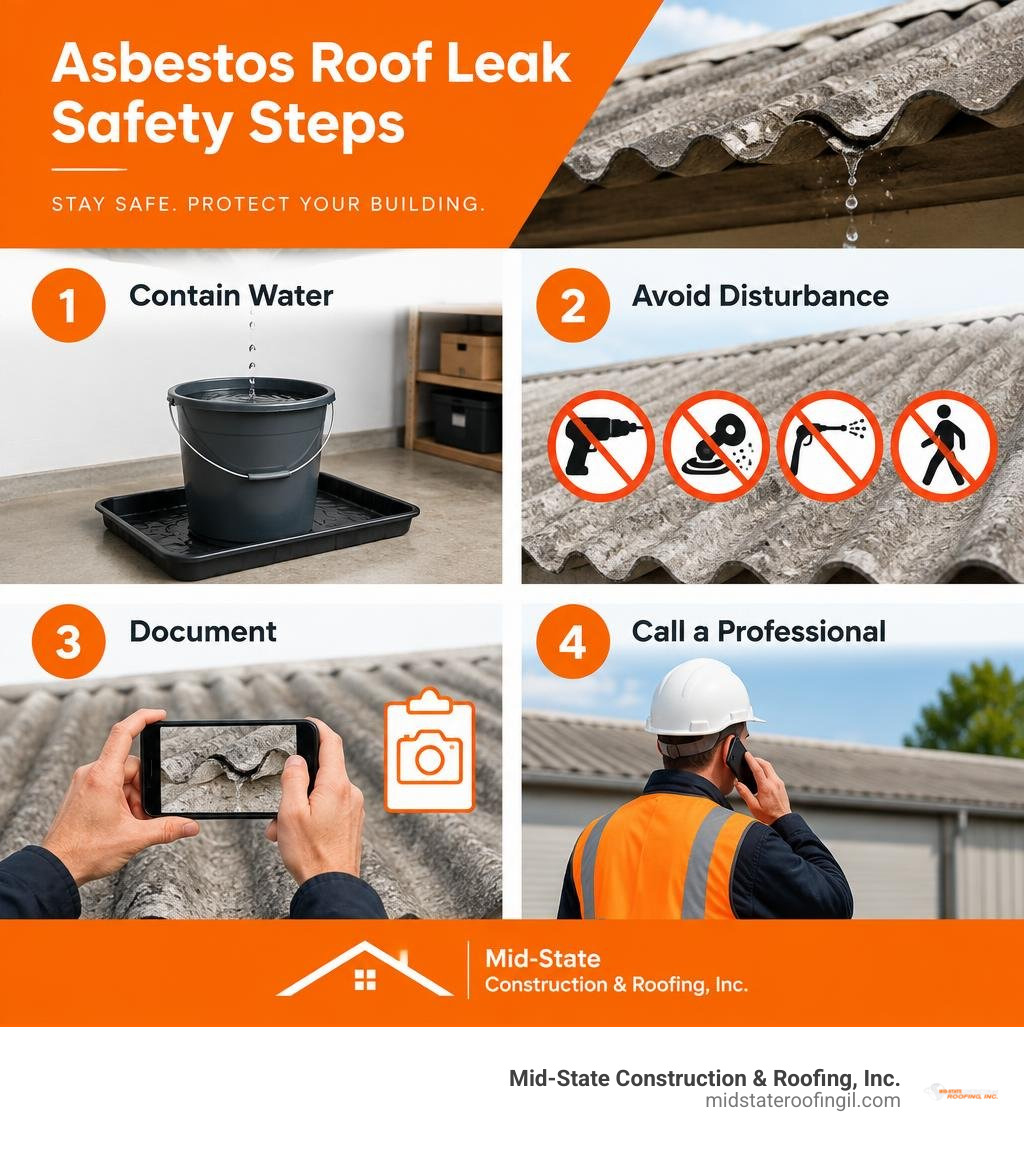
If you find a leak in an asbestos cement roof, contain the water from inside, keep people away from the area, and do not drill, sand, scrape, pressure-wash, or walk directly on the roof. Photograph the leak and inspect from below if possible. Then have the damage assessed before choosing a patch, coating, or replacement.
Asbestos roof leak repair can be safe only when the sheets remain intact and are not disturbed. Many asbestos cement roofs were built for a 30- to 40-year service life, so older garage, farm, and commercial roofs may leak through cracked sheets, worn fixing holes, failed overlaps, or general porosity.
- Use buckets or drip trays to protect floors, equipment, and stored items.
- Avoid power tools and high-pressure cleaning, which can release asbestos fibers.
- Do not use ordinary paint or silicone as a long-term fix.
- Call a qualified roofing or asbestos professional if sheets are broken, sagging, badly weathered, or hard to reach safely.
I am Virgil Strauch, a business leader with practical experience in planning complex property and operational projects where safety, cost, and long-term results matter. In this guide, I will help you understand the decisions involved in asbestos roof leak repair so you can protect your building without taking unnecessary risks.
Immediate Action Plan: Diagnosing Damage and Staying Safe
Finding water dripping into your workspace, garage, or storage bay is stressful. When that water is seeping through corrugated asbestos cement sheets—often containing bonded white chrysotile fibers—your reaction needs to balance speed with strict safety protocols.
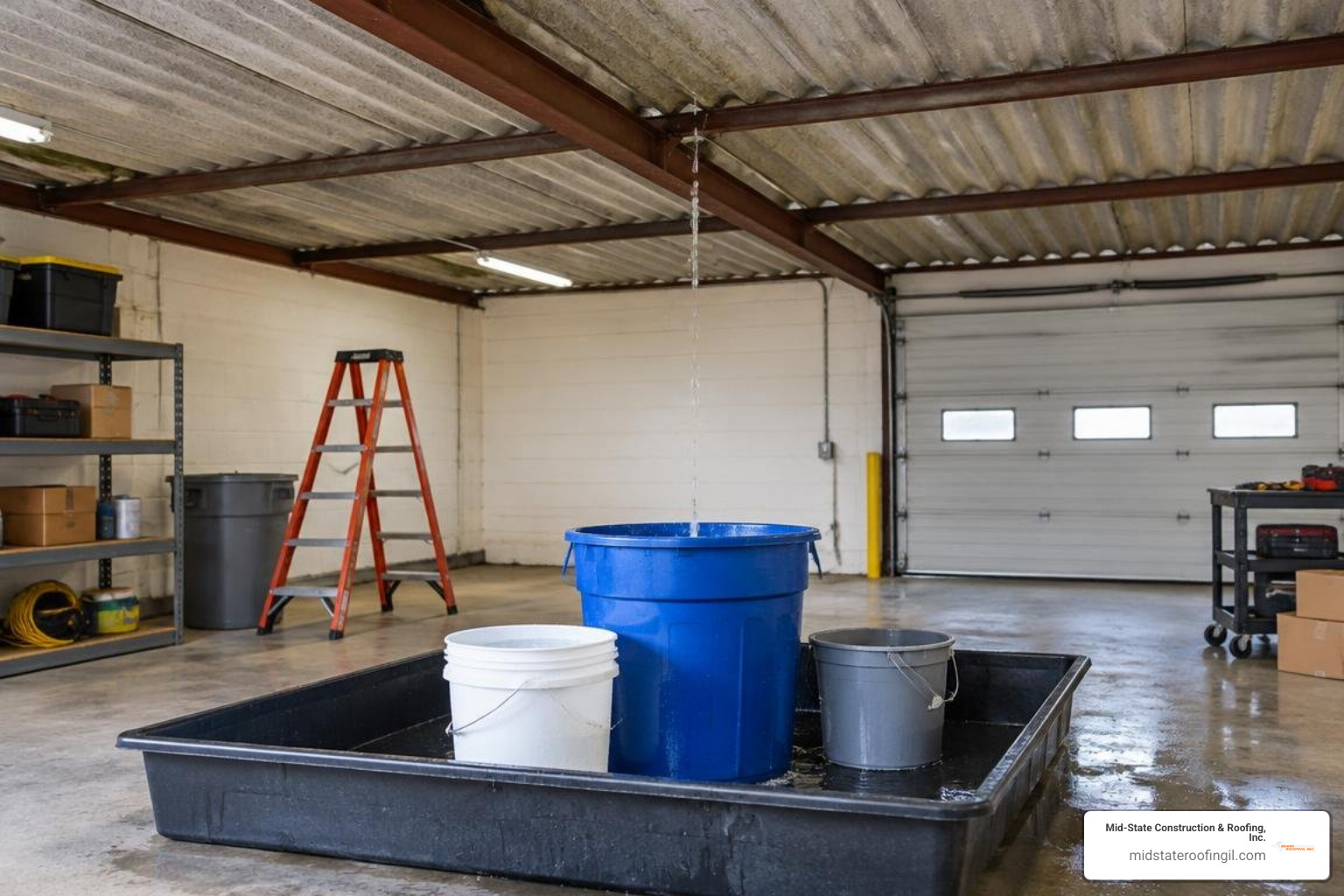
When water enters your facility, follow these initial emergency roof repair procedures to contain internal damage before addressing the exterior:
- Protect Interior Assets: Immediately move tools, inventory, and electrical equipment outside the drip zone.
- Contain the Water: Position heavy-duty drip trays or catchment buckets underneath the intrusion. Choose containers that cover an area at least 50% larger than the visible wet floor patch to catch drifting splashes.
- Document the Damage: Take detailed photographs and video clips of the active leak, the pooling water, and affected structural timbers. Note the exact bay, column number, or ceiling rafter to trace the source later. This photographic record is vital when submitting property insurance claims.
- Establish an Exclusion Zone: Rope off the area below to prevent employees or family members from slipping or coming into contact with potentially contaminated runoff.
Whatever you do, never step directly onto an asbestos roof. Asbestos cement sheets grow increasingly brittle over decades of weather exposure. Stepping onto an unsupported sheet is one of the leading causes of fatal roof falls in commercial and agricultural buildings. If safe access is required, specialists use load-spreading crawler boards and safety harnesses anchored to certified structural points.
Identifying Roof Defect Types: Holes, Cracks, and Porosity
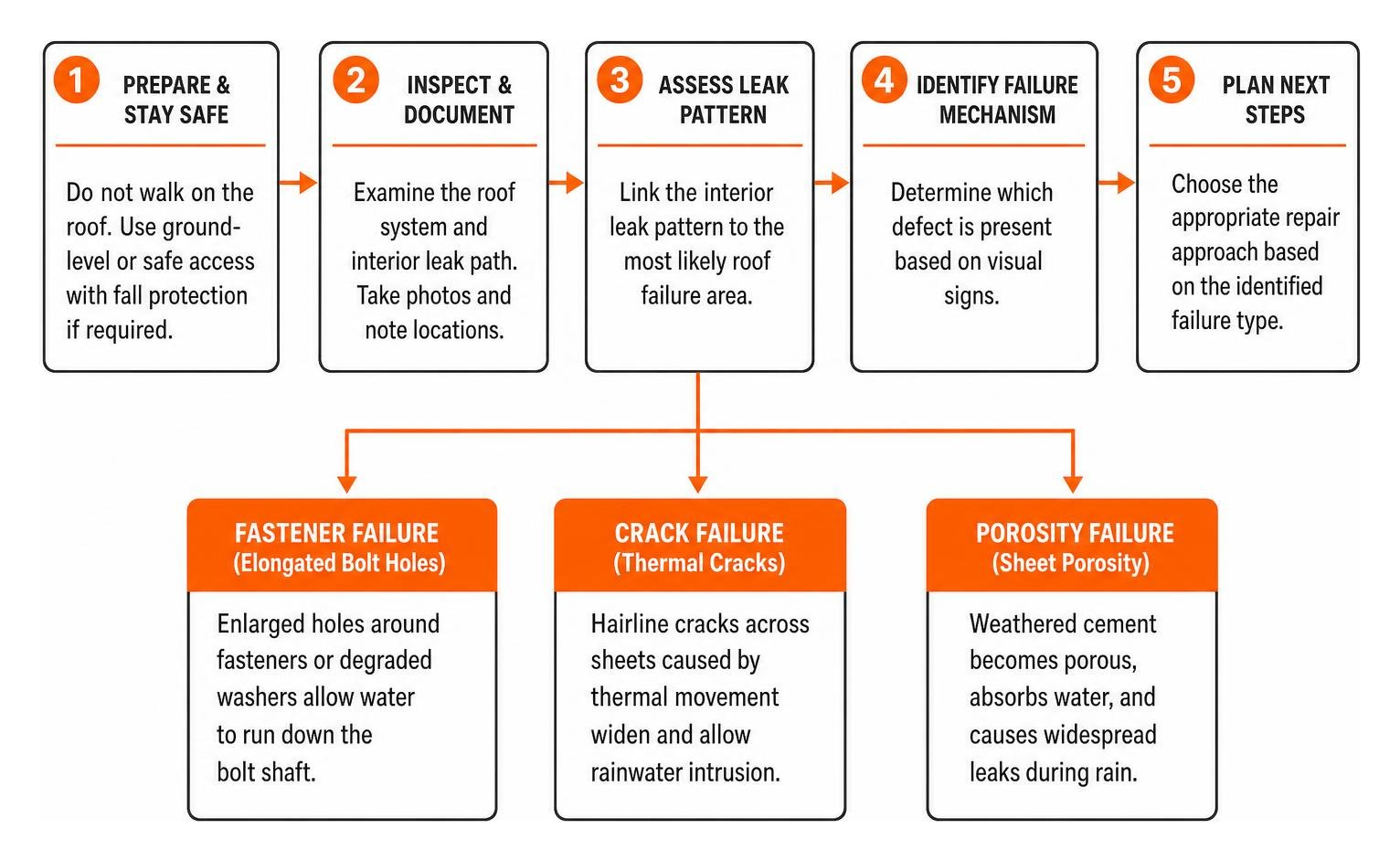
Not all roof leaks originate from the same type of structural failure. Diagnosing the specific failure mechanism helps determine whether a targeted repair or a broader protective coating is necessary:
- Elongated Bolt Holes: Fasteners expand and contract with seasonal temperatures. Over time, original hook bolts enlarge their mounting holes, or the protective rubber and lead washers deteriorate, allowing rain to run directly down the bolt shaft.
- Hairline Thermal Cracks: Corrugated sheets undergo daily thermal shock. This expansion and contraction produces micro-fissures that widen during winter freeze-thaw cycles.
- Sheet Delamination and Porosity: Once the cement binder weathers away, the underlying profile becomes soft and porous, absorbing moisture like a hard sponge and releasing a steady, widespread indoor drip during prolonged downpours.
- Degraded Lap Joints and Flashings: The factory-applied butyl sealants between overlapping vertical and horizontal sheets eventually dry out, shrink, and crack, allowing wind-driven rain to blow upward beneath the panels.
Legal Safety Protocols and PPE Requirements
Working near asbestos-containing materials (ACMs) requires strict adherence to health regulations established by bodies like OSHA in the United States and the Control of Asbestos Regulations (CAR 2012) in the UK.
Non-friable asbestos cement products can be maintained safely without a licensed abatement contractor only if the materials remain unbroken and undisturbed. You can review standard safety parameters in official asbestos safety guidance documents before planning any work.
If you are inspecting or carrying out minor external maintenance, proper Personal Protective Equipment (PPE) is mandatory:
- Respiratory Protection: Wear an approved particulate respirator, such as an FFP3 or N100 half-mask that fits tightly against clean-shaven skin.
- Protective Coveralls: Wear Type 5/6 disposable coveralls with elasticated hood, cuffs, and ankles to prevent stray particles from clinging to your clothing.
- Gloves and Footwear: Heavy-duty nitrile or rubber gloves and easily washable, slip-resistant safety boots.
- Strict Prohibitions: Never use high-pressure washers, wire wheel brushes, circular saws, or abrasive sanding discs on asbestos cement. These power tools pulverize the matrix, launching hazardous fibers into the air.
Materials and Preparation: Safe Surface Cleaning and Product Selection
Proper surface preparation determines whether a patch lasts for years or peels off after the first storm. However, you cannot prepare asbestos like standard sheet metal or wood.
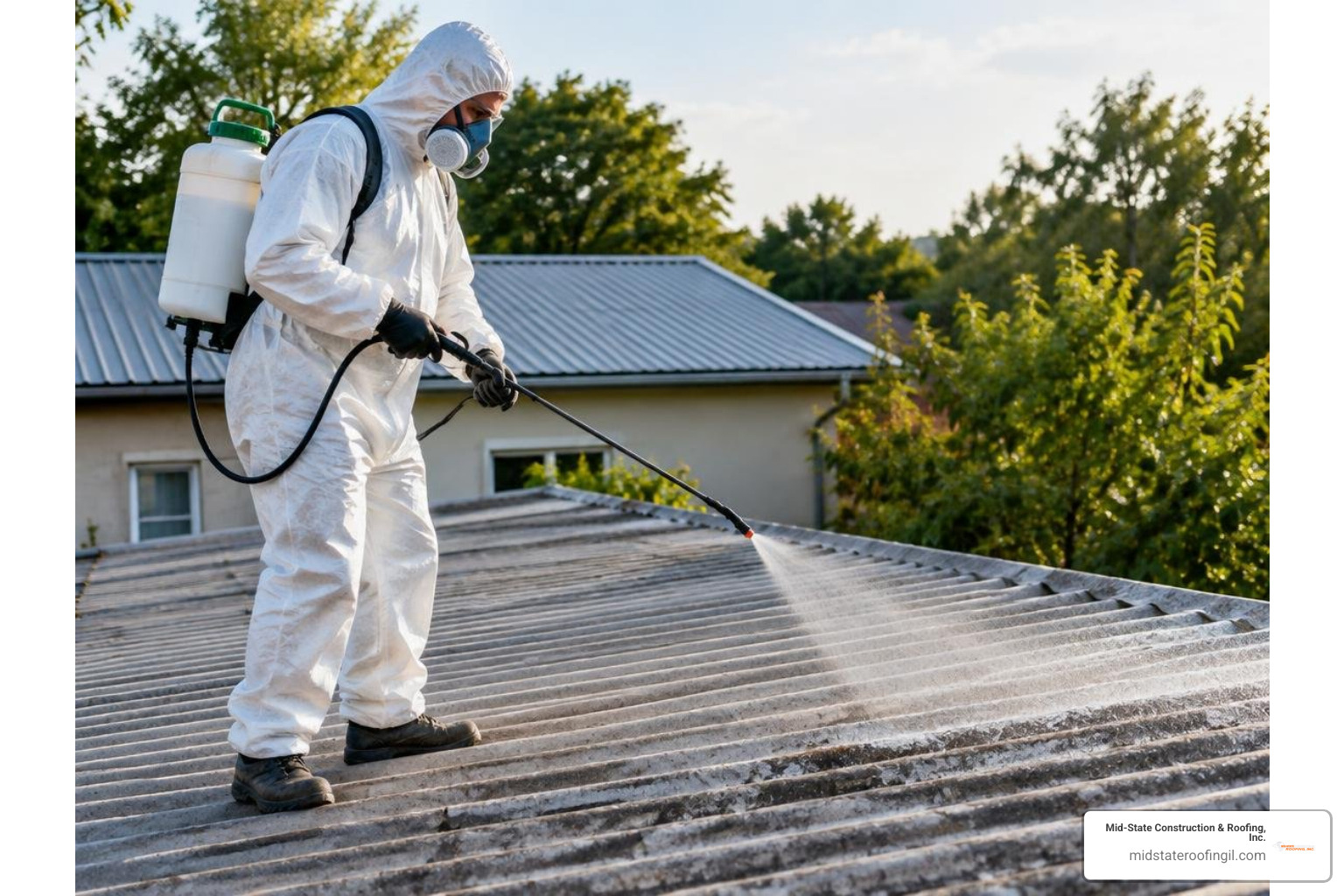
To prep the substrate without releasing airborne particles, use the wet cleaning method:
- Chemical Treatment: Treat thick moss, lichen, and algae growth using a dedicated chemical biocide wash applied with a low-pressure garden-style pump sprayer.
- Dwell Time: Allow the biocide solution to dwell on the surface—often up to several days—to kill the root systems clinging to the cement pores.
- Gentle Debris Removal: Dampen the roof with a soft water mist, then gently sweep away dead biological growth using a soft-bristled broom. Never dry-scrape the sheets.
- Hazardous Waste Management: Collect all dislodged debris, contaminated rags, and used brush heads. Seal them inside heavy-gauge, labeled polythene disposal bags for processing at an authorized hazardous waste facility.
Why Standard Silicone and Bitumen Sealants Fail
It is tempting to grab a tube of general-purpose silicone caulk or a tub of standard black bitumen mastic from a local hardware store. However, using these materials on asbestos cement typically leads to premature failure:
- Silicone Caulk: Standard silicone has poor chemical adhesion to porous, alkaline cement substrates. It sits on top of the surface rather than anchoring into it. As the roof expands under the summer sun, the silicone bond shears away within 3 to 12 months, trapping moisture behind it.
- Bitumen Coatings: While bitumen offers an inexpensive short-term seal, it quickly dries out and oxidizes under ultraviolet (UV) radiation. Within a few seasons, the material hardens, develops alligator cracks, and loses the flexibility needed to accommodate thermal movements.
Top Materials for Asbestos Waterproofing and Patching
For a lasting seal on aged corrugated sheets, utilize commercial-grade, flexible systems specifically engineered for non-friable asbestos:
- Liquid Rubber and Pure Silicone Coatings: High-performance elastomeric coatings, such as liquid EPDM or high-solids silicone membranes (like GacoFlex S42), cure into a seamless rubber barrier. They can stretch up to 300% without tearing, easily handling the thermal movement of large roofs.
- Fiber-Binding Primers: Penetrating stabilizing primers sink deep into porous cement, locking the microscopic mineral fibers into a solid foundation for topcoats.
- UV-Curing Glass-Reinforced Polymer (GRP) Patches: Pre-impregnated fiberglass patches cure rapidly under natural sunlight, forming a rigid, impact-resistant shield over physical holes.
- Cold-Weather Hybrid Sealants: Advanced fiber-reinforced polymer pastes (such as GacoPatch) can be applied in temperatures down to 35°F (2°C), even on damp surfaces, making them indispensable for winter emergency repairs.
Essential Guide to Asbestos Roof Leak Repair and Safety
When managing roof leaks, building owners generally choose between localized patch repairs, seam over-banding, and complete roof encapsulation. Selecting the right path ensures you invest in cost-effective roof repair solutions that resolve active leaks without requiring premature, high-cost structural tear-offs.
For detailed walkthroughs on tackling residential outbuildings, you can consult this helpful guide on how to repair a leaking asbestos garage roof.

Step-by-Step Asbestos Roof Leak Repair Process
Executing a reliable repair on a stable, non-friable sheet requires a methodical approach:
- Stabilize and Wet the Work Area: Lightly mist the damaged profile with water or an encapsulating solution to ensure no loose fibers become airborne while you work.
- Apply a Stabilizing Primer: Brush an asbestos-compatible, fiber-binding primer over and around the damaged area, extending at least 4 to 6 inches beyond the defect. Let it dry according to manufacturer guidelines (typically 4 to 8 hours depending on ambient temperature).
- Bridge Cracks with Scrim Mesh: For cracks up to 3 mm wide, trowel or brush a heavy layer of hybrid polymer sealant directly over the fissure. Embed an open-weave polyester or fiberglass scrim mesh into the wet sealant, smoothing out all air bubbles, and immediately cover it with a second layer of sealant.
- Patch Larger Voids: If an old fastener has left an open hole, cut a UV-curing GRP patch or a heavy butyl-backed aluminum sealing strip to shape. Press the patch firmly onto the primed surface, rolling the edges flat to prevent water tracking underneath.
- Apply Protective Waterproof Coating: Brush or roll two coats of a liquid rubber or elastomeric roof coating across the entire repair zone. Allow the initial layer to cure to a tacky finish before applying the cross-directional second coat.
Comparing Repair Methods, Lifespans, and Costs
Understanding the trade-offs between localized patches, full encapsulation, and structural replacement helps you manage capital expenses effectively:
| Repair Method | Best Suited For | Expected Lifespan | Typical Cost Range |
|---|---|---|---|
| Targeted Patch Repair | Isolated punctures, single cracked sheets, or loose bolts | 2 – 5 Years | $400 – $1,500 per defect |
| Localized Over-Banding | Failed lap joints, ridge seams, and sheet splits | 5 – 8 Years | $1,500 – $5,000 per section |
| Full Liquid Encapsulation | Brittle, porous, multi-leak roofs nearing life expectancy | 15 – 20+ Years | $35 – $55 / m² (Full roof warranty) |
| Complete Roof Replacement | Structurally compromised, sagging, or shattered panels | 40+ Years | 3x to 5x the cost of encapsulation |
If you are managing an unexpected commercial leak, emergency contractor call-out fees typically range from $500 to $1,200 plus material costs to secure the site.
For a broader perspective on UK and European industrial repair approaches, you can learn more about how to stop an asbestos roof leaking in the UK.
Long-Term Strategy: Repair, Encapsulation, or Replacement?
While spot repairs solve immediate water ingress, every building owner eventually faces a larger strategic choice: continue patching, encapsulate the entire surface, or remove the asbestos roof entirely.
Proactive property managers recognize the importance of regular roof maintenance to monitor sheet conditions and catch degradation early. If your roof experiences multiple leak locations each season, evaluate the variables outlined in this guide on roof repair vs replacement considerations.
Full surface encapsulation has become the preferred industry standard for aging industrial facilities. By applying a seamless liquid elastomeric membrane over the entire surface, you effectively lock the asbestos fibers beneath an airtight, watertight barrier.
Encapsulation extends the roof’s operational life by 10 to 20 years, avoids the immense disruption of closing down interior operations, and eliminates the steep hazardous disposal fees associated with full removal.
When to Call a Professional for Asbestos Roof Leak Repair
DIY repairs should be confined to easily accessible, low-level outbuildings with minor, isolated defects. You should immediately call a qualified commercial roofing specialist upon spotting any critical signs that indicate an emergency roof repair:
- Structural Sagging or Bowing: Corrugated sheets that visibly dip between purlins are at immediate risk of collapse.
- Extensive Shattering or Spiderweb Fractures: Panels damaged by fallen tree limbs or severe hail impact cannot be safely patched.
- Widespread Friability: When sheets become so brittle that light contact causes them to crumble into powder, licensed abatement specialists are required.
- Inaccessible Heights: High-pitch commercial facilities or industrial complexes require specialized edge protection, scaffolding, and load-bearing roof ladders that meet OSHA standards.
Frequently Asked Questions About Asbestos Roof Leaks
Can I use standard silicone caulk to fix an asbestos roof leak?
No, standard silicone caulk should not be used. It fails to form an enduring chemical bond with the porous, alkaline surface of aged asbestos cement. Under daily thermal expansion and contraction, silicone quickly pulls away from the substrate, creating a hidden pocket that traps moisture and accelerates deterioration. Use specialized hybrid polymer sealants, fiber-reinforced acrylics, or liquid rubber membranes instead.
Is it legal to clean and coat an asbestos cement roof myself?
In most jurisdictions, homeowners and commercial facility managers are permitted to carry out non-licensable maintenance, such as low-pressure cleaning and brush-applied encapsulation, provided the sheets remain undamaged. However, using high-pressure power washers, mechanical sanders, or wire brushes is strictly prohibited by law, as these abrasive methods release hazardous respirable fibers.
How long does an asbestos roof encapsulation repair last?
A professionally installed full-surface encapsulation system—such as a reinforced liquid EPDM or high-solids silicone system—typically lasts between 15 and 20 years. These liquid membranes are highly resistant to UV degradation and retain over 300% elasticity, providing long-term weather protection.
Conclusion
A leaking asbestos roof does not have to result in an immediate, expensive tear-off. By containing the water quickly from inside, avoiding aggressive cleaning methods that disturb harmful fibers, and utilizing advanced fiber-binding primers and elastomeric coatings, you can safely seal leaks and add decades of reliable performance to your building.
If you are dealing with recurring water intrusion, storm damage, or an aging industrial roof, professional assessment is the safest way forward. At Mid-State Construction & Roofing, Inc., we provide commercial and residential property owners across Effingham, IL, and surrounding areas with expert roofing services. Our industry-leading quality assurance and certified project supervision ensure your roof remains watertight, compliant, and structurally secure for years to come.