
How to Fix Metal Roof Repair Fast by Using These Tips
Metal Roof Repair Guide: Pinpointing Leaks, Seams, and Fasteners
To fix a metal roof leak, start by replacing any backing-out screws with oversized fasteners that have fresh EPDM washers, reseal open lap seams with butyl tape and polyurethane sealant, and patch holes with matching sheet metal secured by stitch screws. These are the most common repairs for exposed-fastener metal roofs. Water is a master of illusion. Because metal roof panels channel moisture along ribs and purlins, the drip hitting your attic insulation might have entered twenty feet uphill.
Before assuming your roof has failed, rule out attic condensation. Condensation presents as widespread, uniform dampness or frost across large sections of your roof decking. An active leak creates localized staining or direct drip trails.
To find the true entry point, follow this systematic process:
- Trace From Below: Head into the attic or crawlspace during daylight. Locate the highest point where water or staining is visible on the framing.
- Transfer Measurements: Measure the distance from that wet point to your exterior walls or ridge, then head outside to the roof surface.
- Inspect the Exterior Zone: Examine the panels directly above that point, looking closely at exposed fasteners, lap joints, pipe boots, and flashings.
- Conduct a Controlled Hose Test: If you cannot spot the opening visually, have a helper watch inside while you run a low-pressure garden hose over isolated sections. Start at the lowest part of the roof and slowly work upward zone by zone. For a deeper breakdown of this diagnostic method, review this expert guide on diagnosing metal roof leaks.
Most leaks stem from thermal cycling. Metal panels expand and contract daily with temperature swings. This movement loosens screws, cracks aged neoprene washers, and pulls seams apart. When addressing a leaking metal roof repair, avoid using household silicone. Standard silicone quickly pulls away under thermal movement. Instead, rely on concealed butyl tape along laps and high-grade, metal-compatible polyurethane sealants for exposed joints, paired with fresh EPDM washers.
Essential DIY Metal Roof Repair Steps for Fasteners and Holes
Backing-out screws are the most common source of leaks on exposed-fastener roofs. As thermal expansion pulls the fasteners loose, water wicks down the screw threads into the roof deck.
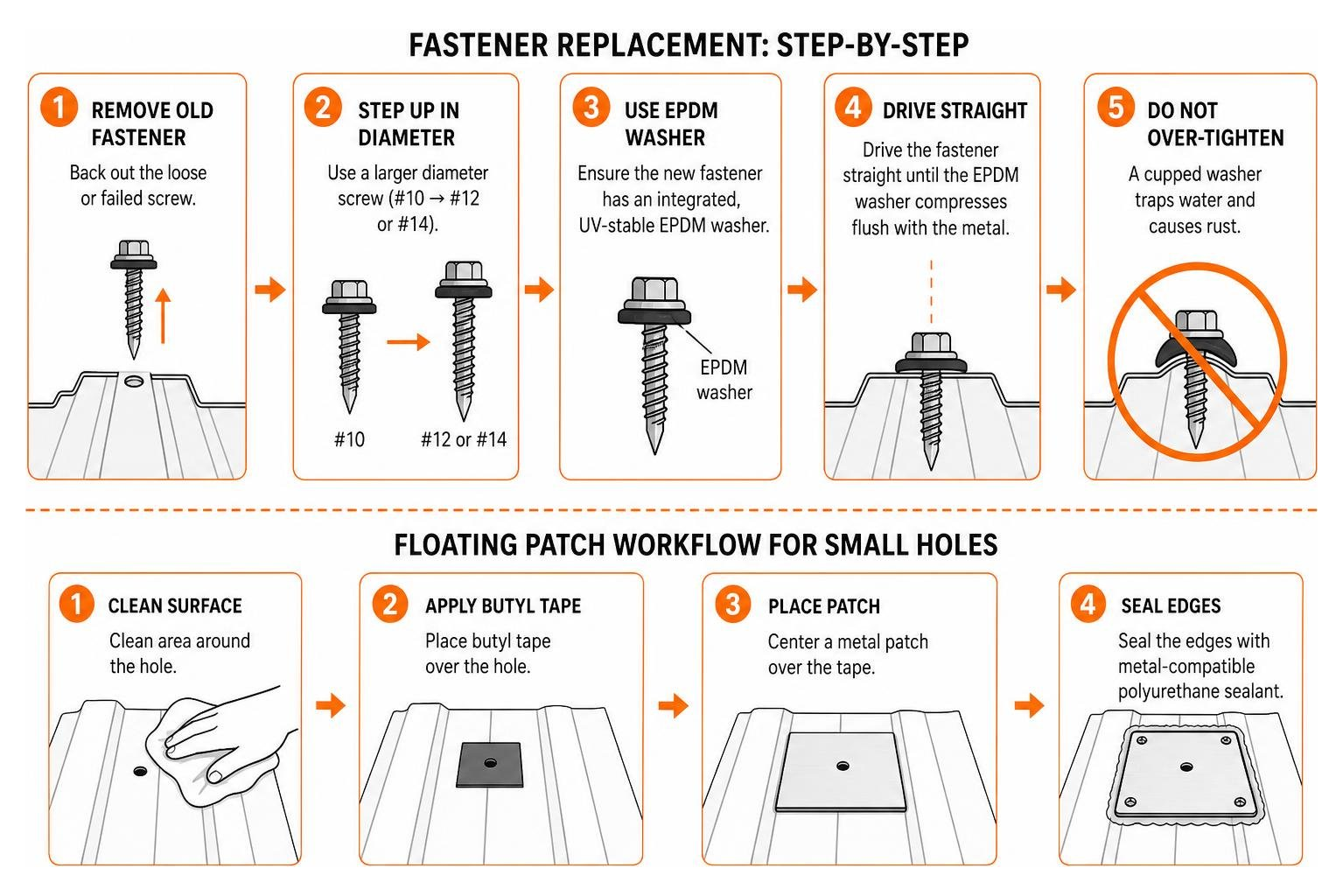
When replacing failed screws:
- Never simply retighten a loose screw. The original hole is likely stripped or enlarged.
- Back out the old screw and step up one screw diameter (for example, replace a #10 screw with an oversized #12 or #14 fastener).
- Ensure the new fastener features an integrated, UV-stable EPDM washer.
- Manage your drill torque: drive the fastener straight until the EPDM washer compresses flush with the metal edge. Never over-tighten, as a cupped washer traps water and accelerates rust.
For holes up to 12 inches across caused by fallen limbs or corrosion, a hybrid floating patch ensures a durable, watertight fix:
- Clean the damaged area at least six inches past the hole.
- Cut a patch from matching metal that overlaps the breach by 3 to 4 inches on all sides. Round every corner of the patch with snips to prevent wind uplift.
- Apply a continuous line of heavy-duty butyl tape around the underside perimeter of the patch.
- Secure the patch using self-drilling stitch screws placed every 2 inches along the border.
- Apply an exterior perimeter bead of polyurethane sealant over the exposed edge and tool it smooth. For a full walkthrough, check out this guide on how to patch a large hole in a metal roof.
Prioritize safety before attempting any DIY repair. Wear soft-soled rubber footwear, secure a sturdy ladder with spreaders, work only on dry surfaces, and practice proper metal roof maintenance.
Seam Failures and Flashing Issues: Exposed Fasteners vs Standing Seam
The structural profile of your roof dictates how you repair seam failures and flashing penetrations.
| Feature / Issue | Exposed-Fastener System | Standing Seam System |
|---|---|---|
| Primary Failure Points | Backed-out screws, dried EPDM washers, lap seam gaps | Sealant failure at transitions, loose end laps, pipe boot cracks |
| Fastener Location | Screws penetrate through the exterior face of panels | Fasteners concealed beneath raised vertical seams |
| Seam Repair Method | Unfasten lap, apply butyl tape, install stitch screws | Reseal joints with polyurethane; re-crimp seams with specialized tools |
| Thermal Movement | High stress on fasteners and washers | Panels float freely on concealed clips |
| Flashing Maintenance | Replace surface screws and exterior caulking | Replace custom-fabricated flashing and concealed clips |
On exposed-fastener roofs, lap joints separate over time as the panels shift. Fix them by cleaning between the overlapping sheets, running a line of concealed butyl tape between the metal layers, and drawing them tight with stitch screws. Replace rigid pipe boots with flexible silicone or EPDM boots rated to handle panel movement.
Standing seam systems conceal their fasteners under raised interlocking ribs, which drastically minimizes leak risks. Understanding the benefits of standing seam metal roofing and weighing the pros and cons of standing seam systems makes it clear why these roofs perform so well. However, when standing seam panels leak, repairs require specialized mechanical seaming tools to re-crimp laps, or precise re-flashing along sidewalls and penetrations.
Stopping Rust, Corrosion, and Surface Prep for Coatings
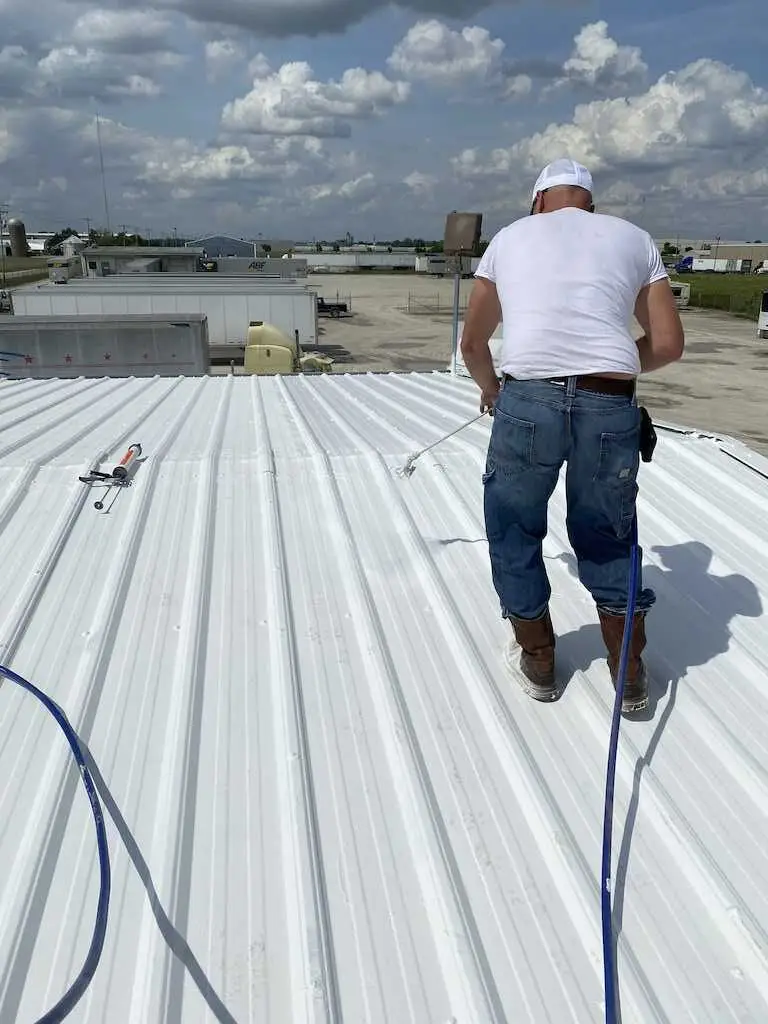
Once factory protective finishes break down, bare steel corrodes at an average rate of 0.1 mm per year under normal environmental conditions, accelerating in harsher climates. Within 5 to 10 years of initial coating failure, rust spots turn into perforations.
Cut edge corrosion frequently occurs where panels were cut during installation, leaving unprotected steel exposed.
To halt rust and prepare panels for protective coatings:
- Mechanical Cleaning: Use a wire brush, abrasive pad, or sandpaper to remove loose rust and flaking paint down to solid, sound metal.
- Degreasing: Clean the surface using acetone or an industrial metal degreaser to strip away oils, grime, and oxidation residue.
- Passivation: Apply a two-component epoxy rust-inhibiting primer. This primer chemically passivates the metal, preventing under-film corrosion from spreading.
- Protective Topcoat: Seal the area with a high-solids elastomeric or silicone coating.
For detailed application steps, reference this step-by-step metal roof coating guide. If your roof shows signs of fading or surface oxidation, exploring acrylic metal coating repairs or applying protective elastomeric metal coatings will restore waterproofing and add decades of service life.
Repair vs. Replacement: Costs, Lifespans, and Long-Term Solutions
Knowing whether to perform isolated repairs, apply a restorative coating, or replace the roof depends on the overall condition of your panels and substructure.
| Roofing Approach | Typical Investment | Expected Lifespan | Best Use Case |
|---|---|---|---|
| Spot Repairs & Re-screwing | $400 – $1,000 per source | 2 – 5 years (maintenance required) | Isolated fastener leaks, branch punctures, single flashing leaks |
| Restorative Coating System | $3 – $7 / sq. ft. (£40–£90 / m²) | 15 – 20+ years (warrantied) | Structurally sound panels with widespread chalking or light surface rust |
| Full Roof Replacement | $15 – $20 / sq. ft. (£80–£150 / m²) | 50 – 60+ years | Structural deck rot, severe rust, multiple large perforations |
When evaluating total roof health, compare your existing system against modern alternatives by comparing asphalt shingles vs metal roofing. While shingles last roughly 20 to 25 years, steel and aluminum panels routinely pass 50 years, and zinc can exceed 80 years. For commercial facilities, commercial metal retrofit solutions can overlay existing metal roofs without disruptive teardowns.
Professional Metal Roof Repair Costs, Warranties, and Lifespans
Hiring a contractor to fix an isolated leak typically costs between $400 and $1,000, depending on roof pitch and the number of penetrations involved. If an exposed-fastener roof needs a complete re-screw with oversized fasteners across the entire slope, plan to inspect screws every 2 to 3 years and budget for full fastener replacement every 7 to 15 years.
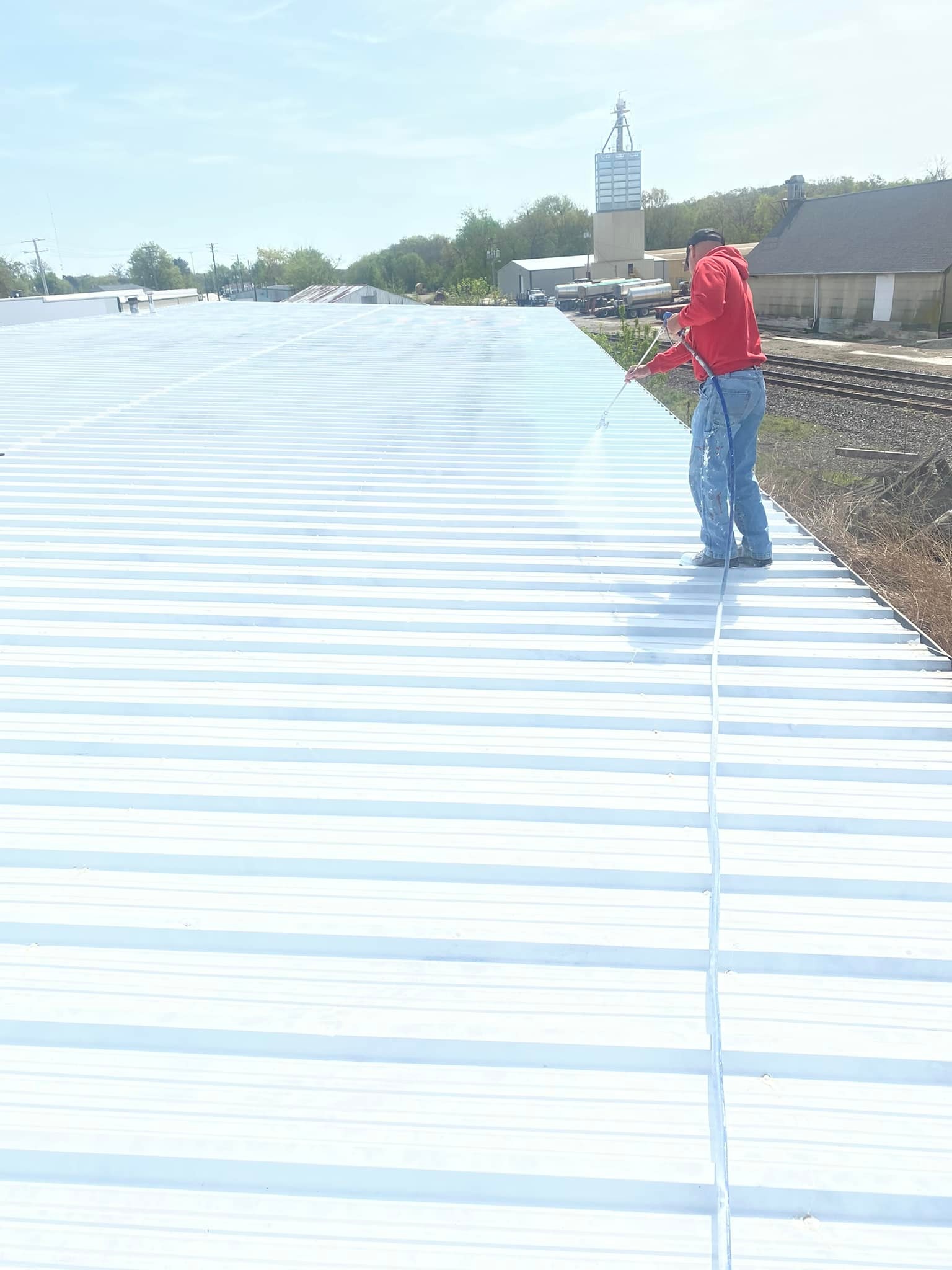
For aging roofs with intact decking, fluid-applied restoration offers massive savings. A full silicone or elastomeric coating system costs $3 to $7 per square foot (or £40 to £90 per m² in the UK), saving roughly 40% to 55% compared to full re-sheeting ($15 to $20 per square foot, or £80 to £150 per m²).
High-performance silicone coatings complete in 5 to 10 days rather than weeks of loud construction, carry robust 20-year manufacturer warranties, and reflect up to 85% of solar radiation—reducing internal building temperatures by up to 10°C.
If panels have deteriorated beyond repair, review your metal roof replacement options or schedule a new residential metal roof installation.
Choosing Between Spot Repairs, Restorative Coatings, and Full Replacement
Use these benchmarks to decide on the best path forward:
- Choose Spot Repairs if your panels are under 15 years old, free of widespread rust, and the leak is isolated to an aged pipe boot, a loose fastener, or a branch puncture.
- Choose Restorative Coatings when you have multiple persistent seam leaks, cut edge corrosion, or weathered factory finishes, but the structural steel still has good integrity.
- Choose Complete Replacement if panels have large, open corrosion holes across multiple sheets, structural purlins are sagging, or underlying roof decking has rotted from long-term water intrusion.
At Mid-State Construction & Roofing, Inc., we know that catching roof problems early protects your entire investment. Our dedicated project managers and quality assurance standards ensure your repairs hold strong against Midwest weather. If you suspect hidden leaks or want a comprehensive assessment of your roof’s condition, contact Mid-State Construction & Roofing, Inc. today to schedule an inspection.