
Stop the Leaks: What You Should Really Pay for a New Flat Roof
Average Flat Roof Replacement Cost in 2026
When planning your roofing budget in 2026, understanding national averages alongside local pricing helps you evaluate contractor bids accurately. Across residential additions, detached garages, and large commercial facilities, low-slope roofs require specialized installation techniques that differ significantly from sloped asphalt shingle roofs.
While basic membrane installations start around $4 to $7 per square foot for material and direct labor, comprehensive replacements that address underlying insulation, edge metal, and deck repairs typically land between $7 and $15 per square foot. Commercial systems requiring high-performance insulation and custom tapered layouts can reach $11 to $18 per square foot.
The table below outlines installed cost expectations, lifespans, and labor rates across the most widely used low-slope materials in 2026:
| Roofing Material | Installed Cost / Sq. Ft. | Typical Lifespan | Common Application | Labor Intensity |
|---|---|---|---|---|
| EPDM (Rubber) | $5.00 – $13.00 | 20 – 30 years | Residential & Commercial | Moderate |
| TPO (Single-Ply) | $4.00 – $14.00 | 20 – 25 years | Commercial & Light Commercial | Moderate-High (Welded) |
| PVC (Single-Ply) | $7.00 – $14.00 | 25 – 30+ years | Commercial (Grease/Chemical) | High (Hot-Air Welded) |
| Modified Bitumen | $4.00 – $9.00 | 15 – 20 years | Residential Porches & Commercial | Moderate-High (Torch/Cold) |
| Built-Up Roof (BUR) | $4.00 – $10.00 | 15 – 25 years | Heavy Commercial / Industrial | Very High (Multi-Ply Asphalt) |
For property owners who want a customized look at their prospective layout before gathering contractor estimates, using an independent customizable pricing model breakdown is a great way to baseline material volumes, pitch variables, and labor hours.
How Roof Size and Square Footage Shape Flat Roof Replacement Cost
Total square footage is the primary driver of project pricing, but unit costs do not scale in a simple straight line. Smaller projects—such as a 400-square-foot residential porch or an 800-square-foot detached garage—carry higher overhead per square foot due to base mobilization charges, safety setup, minimum crew sizes, and equipment hauling fees.
As roof square footage increases into mid-size and large facilities, economies of scale begin to reduce your cost per square foot:
- Small Residential (under 1,000 sq. ft.): $5.50 – $16.00 per sq. ft. due to minimum project overhead charges.
- Medium Residential & Light Commercial (1,000 – 3,000 sq. ft.): $4.00 – $14.00 per sq. ft.
- Large Commercial (3,000 – 10,000+ sq. ft.): $4.00 – $11.00 per sq. ft. as material volume discounts and efficient field runs lower per-square labor rates.
Beyond raw area, the complexity of penetrations, HVAC curbs, parapet perimeters, and multi-story access requirements play a major role in influencing roofing expenses.
Single-Ply Membrane Options: TPO, PVC, and EPDM
Modern low-slope installations rely heavily on single-ply membranes because of their clean installation process and dependable performance. A quality single-ply flat roof typically falls into one of three primary chemical families:
- TPO (Thermoplastic Polyolefin): Currently the dominant commercial roofing membrane in North America. TPO features hot-air welded seams that fuse adjacent sheets into a monolithic, watertight barrier. It provides exceptional resistance to UV degradation, heat buildup, and biological growth.
- PVC (Polyvinyl Chloride): A premium thermoplastic sheet engineered with plasticizers for long-term flexibility. PVC features heat-welded seams similar to TPO but offers superior chemical resistance against oils, grease, and industrial rooftop pollutants. While costing roughly 15% to 25% more than TPO, it provides a longer verified service life.
- EPDM (Ethylene Propylene Diene Monomer): The proven workhorse of the industry. Choosing durable rubber roofing systems provides exceptional elasticity in regions with extreme temperature swings. EPDM resists ozone cracking and thermal shock, with large single sheets minimizing the total number of field seams. Seams are joined using specialized seam tape and primer systems.
Traditional Built-Up (BUR) and Modified Bitumen Systems
Multi-ply asphalt assemblies remain popular for high-traffic environments where foot traffic or equipment servicing requires heavy puncture resistance.
Built-Up Roofing (BUR) alternates layers of bitumen-saturated organic or fiberglass felts with hot asphalt, topped with aggregate gravel or reflective coatings. While labor-intensive to install, BUR offers redundant waterproofing layers.
Modified Bitumen advances traditional BUR technology by infusing asphalt with synthetic rubbers (SBS) or plastics (APP), factory-laminating the blend onto fiberglass or polyester reinforcement mats. It is installed using heat welding (torch-down), cold process adhesives, or self-adhering membranes.
When evaluating what’s the best flat roofing material for a specific building, property owners often compare single-ply against modified bitumen to match site-specific fire ratings, chemical exposure, and foot-traffic demands. Reviewing your operational requirements will point you toward the most dependable commercial roof material selection.
Key Factors That Drive the Total Cost of Flat Roof Replacement
Flat roof systems require far more than unrolling a single layer of waterproof material. A complete installation consists of several integrated components—including structural decking, thermal insulation, vapor retarders, cover boards, edge metals, and flashings. Every phase of this assembly affects your final investment.
Tear-Off vs. Overlay: Impact on Flat Roof Replacement Cost
One of the largest financial decisions on any project is deciding between a complete tear-off and a roof recover (overlay).
A roof recover involves placing a separator sheet or thin insulation board directly over the existing single-layer membrane, followed by a new membrane. This avoids tear-off labor and dumpster fees, saving roughly $1.00 to $3.00 per square foot (a 20% to 35% reduction in immediate project cost).
However, building codes generally limit roofs to a maximum of two assemblies. If your roof already has two layers, complete removal down to the structural deck is mandatory. Even when permitted, an overlay carries distinct operational risks:
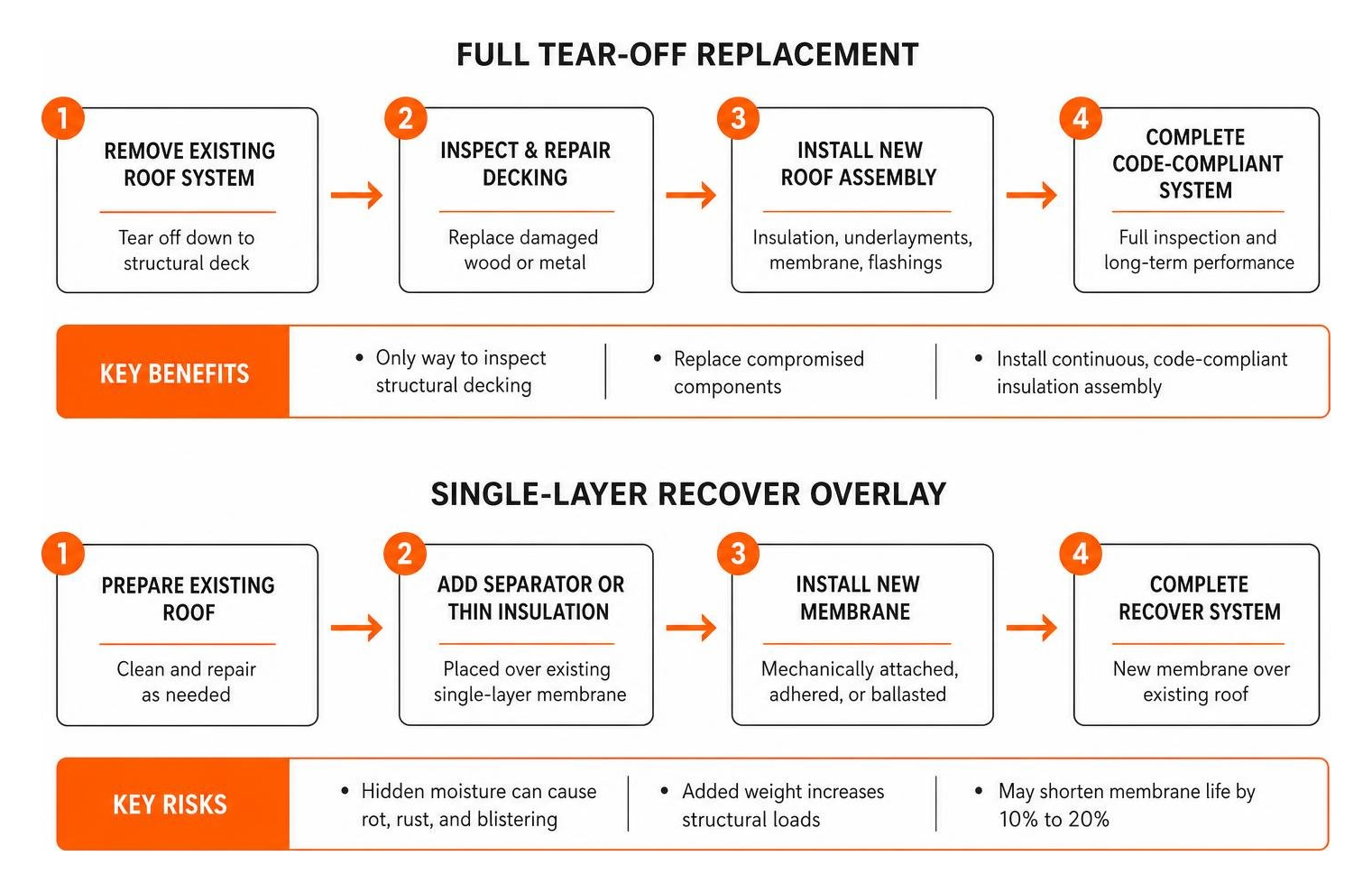
- Hidden Moisture: Trapping wet insulation under a new membrane leads to ongoing structural rot, decking rust, and premature membrane blistering.
- Structural Weight Limits: Adding a second layer increases dead loads on ceiling joists and support purlins.
- Reduced Service Life: Overlays often shorten the effective lifespan of the new membrane by 10% to 20% due to trapped heat and uneven substrate movement.
A complete tear-off adds disposal expenses, but it is the only way to inspect the structural decking, replace compromised wood or metal, and install a continuous, code-compliant insulation assembly.
Insulation Upgrades, Sloping, and Drainage Systems
Modern energy codes require minimum continuous insulation values above the roof deck (typically R-25 to R-30). Polyisocyanurate (polyiso) rigid foam is the industry benchmark, providing roughly R-5.7 to R-6.0 per inch of thickness. Upgrading continuous insulation to meet building codes adds $2.00 to $5.00 per square foot to project estimates, but it delivers substantial year-round energy savings.
Flat roofs must never be entirely level; they require a positive slope (minimum 1/4 inch per foot) to shed water toward drainage points. When a structural deck lacks natural slope, a custom tapered insulation system must be engineered. Tapered polyiso crickets and sloped boards eliminate standing water but require meticulous drafting and installation, typically adding $2.00 to $4.50 per square foot.
Properly sizing and retrofitting internal drains ($300 to $500 each) and exterior scupper boxes ($400 to $700 each) prevents water accumulation, protecting the building against structural stress.
Fastening Methods and Labor Installation Complexity
Labor accounts for 40% to 60% of the total cost to replace a low-slope roof, and the attachment method selected directly influences crew labor hours:
- Mechanically Fastened: Insulation boards and membrane sheets are secured directly through the roof deck with specialized heavy-duty screws and barbed stress plates. This is the fastest, most cost-effective method ($2.00 to $3.00 per sq. ft. labor), though membranes may slightly flutter or billow during extreme high-wind events.
- Fully Adhered: The membrane is chemically bonded to the underlying high-density cover board using water-based or solvent-based adhesives. This produces a smooth, aesthetically clean finish with superior wind uplift resistance, adding $2.75 to $3.50 per square foot in material and labor.
- Ballasted: The membrane is laid loose over insulation and held in place by rounded river stone or concrete pavers (10 to 12 lbs per square foot). While offering low upfront labor costs ($1.50 to $2.00 per sq. ft.), ballasting requires heavy structural load capacity and makes pinpointing future sub-membrane leaks difficult.
Penetrations significantly increase labor. Installing custom-molded pipe boots, curbs around commercial HVAC systems, skylight flashing kits, and continuous 24-gauge perimeter coping metal requires precise craftmanship that adds to on-site labor hours.

Repair vs. Replace: Making the Right Long-Term Financial Choice
Property owners often face a tough question when a leak occurs: can this roof be patched, or is it time for a complete replacement? Understanding the signs your flat roof needs repair helps you avoid spending money on temporary patches when structural components are compromised.
Small, isolated punctures from dropped tools, localized seam splits under 10 feet, or failing pipe boot collars can be economically repaired for $350 to $1,200. Reviewing field-tested strategies for resolving common flat roofing issues will help you handle isolated defects without disrupting your building’s operations.
However, continuous spot-patching becomes a financial drain when the underlying substrate is saturated. The widely accepted roofing standard is the 25% Rule: if active damage, wet insulation, or seam failure affects more than 20% to 25% of the total roof surface, full replacement is significantly more economical over a 5-year outlook than continuing to patch failing materials.
Evaluating Membrane Lifespan and Energy Savings
A low-slope roof’s life expectancy depends heavily on proper maintenance, climate factors, and drainage performance. As detailed in our guide on the life expectancy of a commercial flat roof, single-ply installations that are well-maintained consistently provide 20 to 30 years of reliable service.
Upgrading to a highly reflective “cool roof”—such as a bright white TPO or PVC membrane—also helps offset replacement expenses over time. White single-ply membranes reflect up to 80% of solar radiation, reducing rooftop surface temperatures from 160°F down to 100°F on hot summer afternoons. This lower surface heat reduces the thermal load transferred into your building, saving property owners 10% to 25% on annual cooling costs. Independent data trackers like Fixr’s flat roof installation guide confirm that these cool-roof efficiency savings consistently lower long-term operating costs in warm weather.
Material Warranties vs. No Dollar Limit (NDL) Coverage
When reviewing replacement estimates, make sure to evaluate the warranty terms. Roofing warranties generally fall into two categories:
- Standard Manufacturer Material Warranty: Included in the base cost of the membrane. This covers factory defects in the material itself for 10 to 20 years. However, it does not cover leaks caused by installation errors, flashing details, workmanship, or contractor failure.
- No Dollar Limit (NDL) System Warranty: A premium, comprehensive warranty issued directly by the material manufacturer (such as Carlisle, GAF, or Firestone). An NDL warranty covers all labor and materials required to fix leaks over a 15- to 30-year period, with no cap on repair expenses.
To issue an NDL warranty, manufacturers require the installation to be completed by a certified contractor who follows strict fastening patterns, flashing details, and passes a mandatory on-site technical inspection by a manufacturer field representative. Securing clear roof replacement estimates ensures you know whether your quote includes basic material coverage or full, manufacturer-inspected NDL system protection.
Frequently Asked Questions About Flat Roof Replacement
Can a homeowner safely DIY a flat roof replacement?
We strongly advise against DIY flat roof replacements. Unlike sloped shingle roofs where water naturally sheds downward, low-slope roofs rely on completely sealed, watertight joints. Modern membranes like TPO and PVC require hot-air welding equipment that costs thousands of dollars and demands precise temperature, speed, and pressure control to achieve true molecular fusion. Modified bitumen systems often involve open flames (torches) or specialized hot-asphalt kettles that carry severe fire hazards. Furthermore, improper detailing around parapet walls, drains, and vents leads to rapid interior leaks, structural deck rot, and the total forfeiture of manufacturer material warranties.
Does replacing a flat roof increase home or building value?
Yes. Installing a new flat roof provides an immediate return on investment, allowing residential and commercial owners to recoup approximately 50% to 70% of the project’s cost upon property resale. A certified, freshly installed roof removes a major negotiation hurdle during property inspections, ensures compliance with municipal energy codes, and protects interior finishes. For commercial assets, a transferable long-term NDL warranty enhances appraisal values and improves tenant retention.
What is the 25% rule for flat roof replacement?
The 25% rule is an industry guideline used by roofers, insurance adjusters, and building code officials. It states that if more than 25% of a roof system’s total area is degraded, leaking, blistered, or underlain by wet, saturated insulation, performing localized patches is no longer financially viable. At this stage, underlying moisture migration and widespread seam stress will cause new leaks faster than old ones can be patched. Investing those repair funds into a full replacement protects your building’s structural integrity and resets the system’s service life.
Conclusion
Replacing a low-slope roof is a major structural investment that protects your building’s interior, cuts energy bills, and delivers lasting peace of mind. While average installed pricing in 2026 spans from $4 to $14 per square foot, the key to lasting performance lies in a quality installation—incorporating continuous insulation, positive drainage slopes, properly detailed flashing curbs, and dependable manufacturer warranties.
At Mid-State Construction & Roofing, Inc., we bring extensive experience, rigorous quality assurance protocols, and dedicated on-site supervision to every commercial and residential project across Effingham, Shelbyville, Altamont, Vandalia, Hillsboro, and surrounding central Illinois communities. Our teams ensure every square of your roof is installed to strict manufacturer specifications.
If your low-slope roof is showing signs of age, chronic pooling, or seam failure, don’t wait for interior water damage to mount. Schedule a comprehensive flat roof replacement consultation with Mid-State Construction & Roofing, Inc. today to get an accurate, line-item proposal tailored to your property.